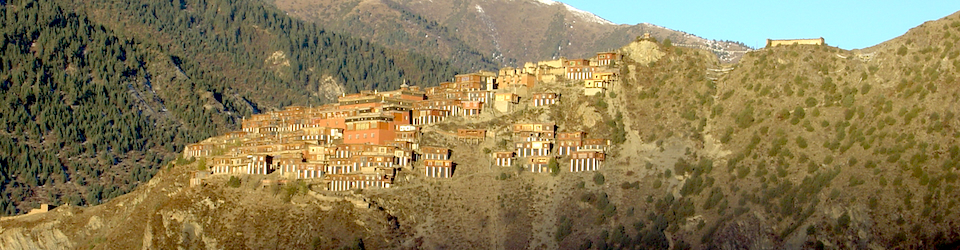
Not so long ago, while busily researching and translating texts about destroying the ‘house’ of the ordinary reactive mind—sem in Tibetan—I lived in a building whose main entrance was emblazoned with the letters S.E.M., as part of the logo of Sterling Estates Management. On several occasions I even travelled from this building labelled S.E.M. to one labelled Rigpa, just a few miles away in another part of north London. Was this an extraordinary coincidence? Or does everybody enact such symbolic representations of the Dzogchen path, proceeding from reactivity to awareness?
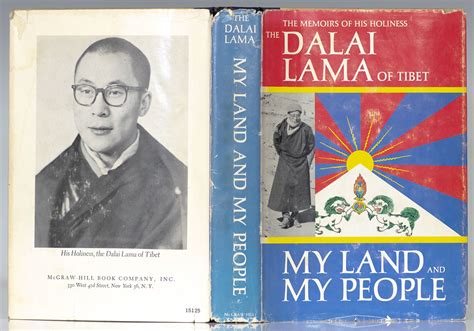
After several years living in S.E.M, so to speak, I moved to a small terraced cottage in East Sussex. Now, one of the challenges of being a neo-lotsawa is deciding how best to respond to the question of what I do for a living. I can’t recall how I phrased my answer when introduced to our new neighbour Jo, but, rather than provoking the usual combination of puzzlement and concern, whatever I said led her to reveal that her late husband David had been a close friend of the Dalai Lama. For it turned out that I was now living next door to the widow of David Howarth, editor of the Dalai Lama’s first autobiography, My Land and My People.
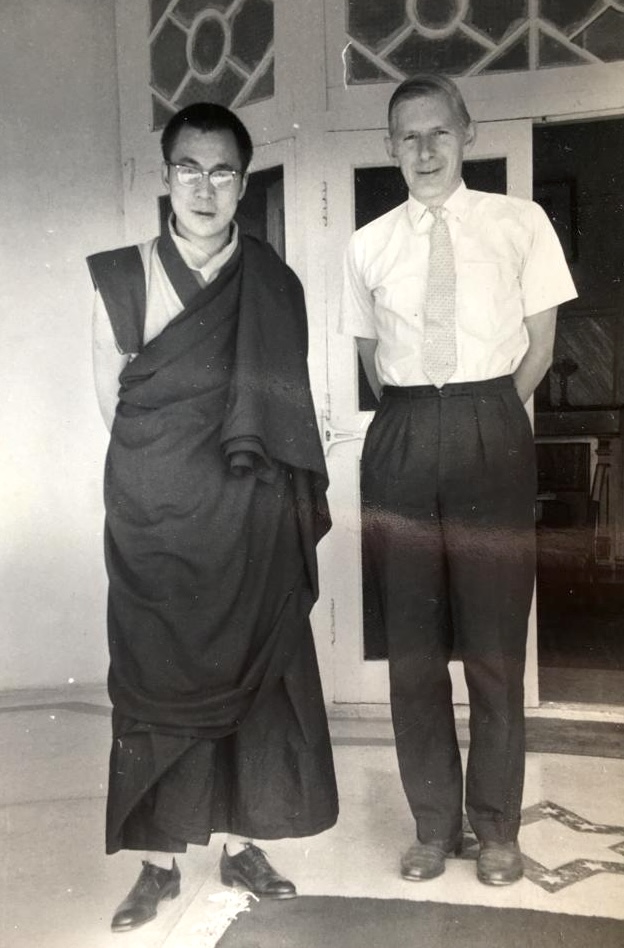
Howarth spent two and a half months in Dharamsala in 1962 working closely with His Holiness and the translator Sonam T. Kazi (1925–2009), as well as the Dalai Lama’s principal secretary, Tenzin Chonyi (T.C.) Tara (1920–2013). In subsequent years, he would meet His Holiness whenever the latter visited the UK, and, as Jo recalled, exchange gifts and lighthearted conversation.
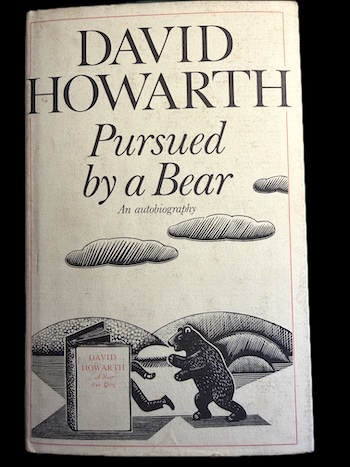
One of the consequences of this coincidental proximity was that it inspired me to read David Howarth’s other books, including his own memoir, Pursued by a Bear, which includes a chapter on his collaboration with His Holiness in the early 1960s. Primarily a historian, Howarth led a fascinating life and was, as the New Yorker put it, “a brilliant writer, full of grace and wit and solid common sense.”
In 2022, shortly after reading Pursued by a Bear, I was invited to participate in a panel at the IATS conference in Prague. My talk—on the writings of Jamyang Khyentse Chökyi Lodrö—would follow that of a young Tibetan scholar, Dhondup T. Rekjong, whose paper, entitled ‘Knowing Tibet: The Centrality of the Dalai Lama’s Autobiography’, focused on My Land and My People. When the panellists convened prior to the session, I was able to show Rekjong-la a photograph of His Holiness the Dalai Lama with David Howarth in Dharamsala in 1962.
Dhondup T. Rekjong eventually wrote an article about My Land and My People that drew upon the more-than-fifty letters that David Howarth exchanged with His Holiness the Dalai Lama between 1961 and 1962. The article shows how the unusual style of the Tibetan-language version of the book, the result of such unprecedented collaboration, had an impact on a number of literary figures inside Tibet, who saw in it a new model for autobiographical writing. Some of the book’s originality is clearly attributable to David Howarth, who had originally been drafted by the publishers, McGraw Hill, to advise on how best to construct the narrative.
But it would seem that influence was not entirely one-directional. In Pursued by a Bear Howarth writes of the Dalai Lama:
I am lucky to have met him when he was young and to have known him so long. He never made me a Buddhist, but he would not have wanted to. He did make me a better man, more patient and tolerant and kinder than I was.
Pursued by a Bear, p. 204
The book ends with a plea for kindness:
Kindness has many names, love, compassion, charity – call it what you like, they all mean the same. It is the quality that encompasses all virtue. Christ said it of course: ‘Love thy neighbour.’ St Paul said it many times: ‘And now abideth faith, hope, and charity, these three: but the greatest of these is charity.’ The Beatles said it, echoing St Paul: ‘All you need is love.’ And the Dalai Lama on his different foundation says it too, not claiming it as a Buddhist virtue, but as the essence of all religions.
Pursued by a Bear, p. 240
Love thy neighbour indeed.
Further Reading
Dalai Lama. My Land and My People: The Autobiography of His Holiness the Dalai Lama. Edited by David Howarth. London: Weidenfield and Nicolson, 1962.
Howarth, David. Pursued by a Bear: An Autobiography. London: Collins, 1986.
Rekjong, Dhondup T. “The Forgotten History of the Dalai Lama’s Autobiography: Secular, Oral and Transnational Stories” in Contemporary Buddhism 2004, vol. 25, nos 1–2, 196–215

