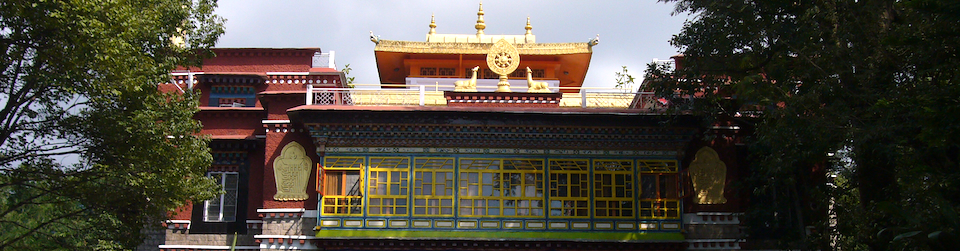
Khenpo Lodrö Zangpo was a disciple of Jamyang Khyentse Chökyi Lodrö and a teacher to several prominent lamas of recent times, including Dzongsar Khyentse Rinpoche, Sogyal Rinpoche, Ringu Tulku Rinpoche and Khenpo Ngawang Jorden.
The following is extracted from an interview with Ringu Tulku Rinpoche that took place in Boudha, Nepal, 10 Sep 2019.
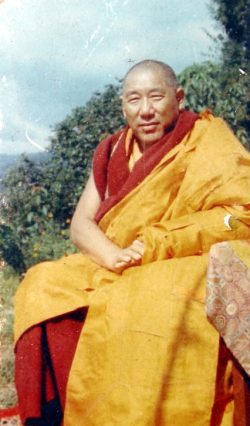
“He and Khenpo Rinchen were like brothers. I don’t know if they had the same father or mother, but they were from the same monastery—Tritso (khri tsho)—and they studied together. They were like brothers.
“At the Namgyal Institute of Tibetology in Sikkim they appointed four lamas as experts. For the Nyingma it was Dodrupchen Rinpoche; for Kagyü it was Gyaltön Rinpoche (1908–1970); and for Sakya it was Khenpo Lodrö Zangpo.1 For the Geluk it was Punkhang Rechung Rinpoche (1927–2001).
“Gyaltön Rinpoche used to be at the institute sometimes. Dodrupchen Rinpoche began by coming every day when we were studying there. But Khenpo Lodrö Zangpo came there every day and stayed the whole day. He lived for a few years in the Nyingma Shedra. Then he lived mostly in the Institute of Tibetology’s guest house. In fact, he lived there until he died.
“He was also the khenpo of Ngor Monastery, the only Sakya monastery in Sikkim. He built it, you could say. He was a very good khenpo. He wrote a commentary on Sakya Paṇḍita’s Tsema Rikter2 and another on the Abhidharmakośa. He could teach texts like Tsema Rikter, Abhidharmakośa, or Abhisamayālaṃkāra by heart. He didn’t need the support of books.
“He also taught Dzongsar Khyentse Rinpoche. We studied the Uttaratantra (Gyü Lama) and a few other things together. I studied mostly with Khenpo when I was in Sikkim, because he was there all the time and he was very happy to teach. It was as if the best thing you could do was to ask him to teach something. You could go there early in the morning or late in the evening—it didn’t matter. He would be there any time. And he would give you a teaching. He would give you tea… he would give you a biscuit… and it felt as if you were doing him a favour.
“I went mostly by myself, but I sometimes went with others, such as Khenpo Ngawang Jorden, who was younger than me and later went on to get a PhD from Harvard.
“Khenpo Lodrö Zangpo had no idea how to chat! He could either talk about Dharma or not at all. The institute once had a visit from a very learned Indian professor from Varanasi, who later became a Buddhist.3 He was teaching in the Sanskrit university. People said to Khenpo Lodrö Zangpo that he should make conversation with this professor. But when they met he didn’t say anything. He just sat there. People were trying to prompt him to say something. Eventually, he just said, ‘So, you’re like Dharmakīrti then.’ To which, the professor replied, ‘No. No, I’m nothing like Dharmakīrti.’ That was it; that was the only thing he said!
“He also built a small monastery in Bodhgayā, and it was there that he died. He was not very old, only around sixty.”
Notes
- He took over in this role from Khenpo Appey (1927–2010), with whom he had studied under Khenpo Drayab Lodrö. ↩︎
- Khenpo’s writings were published in three volumes in 1978. The Tsema Rikter commentary was not included in that three-volume collection but published separately in Gangtok and is available in BDRC as W1KG22449. ↩︎
- Possibly Pandit Jagannath Upadhyaya. ↩︎
Further Reading
Acharya Tsultem Gyatso. Biographies of Contemporary Tibetan Lamas & Their Contributions to Sikkim. Gangtok, Sikkim: Namgyal Institute of Tibetology, 2016
Acharya Tsultrim Gyatso. sbas yul ‘bras mo ljongs su deng rabs bod kyi bla ma skyes chen dam pa rnams kyis mdzad pa phyag ris ji bskyangs kyi rnam thar shin tu bsdus pa. Gangtok, Sikkim: Namgyal Institute of Tibetology, 2008
sa skya mkhan po blo gros bzang po. “sde dge khri tsho dgon pa dang rtsam po pa rang nyid kyi byung ba brjod pa mdor bsdus su bkod pa” in A short account of monastic life in Dodrup (Golok), Khritsho (Derge) and Kyibuk (Tsang) Monasteries. Gangtok: Sikkim Institute of Tibetology, 1976.

