Author Archives: Adam

Yet More on the Dates of Orgyen Tendzin Norbu

Khenpo_Jamgyal
Ga Lama Jamyang Gyaltsen, alias Jamgyal

This is really just an addendum to the previous post. While looking for something else I noticed the following:

In David Jackson’s A Saint in Seattle (Wisdom Publications, 2003) there is a section based on the biography of Ga Lama Jamyang Gyaltsen (alias Jamgyal, 1870–1940) by Dezhung Rinpoche. There it says that Jamgyal first heard the name of his root teacher, Khenpo Shenga, some time after being thrown out of Tharlam Monastery (for trying to reform the discipline there). The expulsion happened when he was in his late twenties, i.e., the late 1890s. Some time after this he met an old monk from Gemang hermitage in Dzachukha. Jamgyal asked him who was in charge there now that Orgyen Tendzin Norbu had passed away (In Tibetan: deng sang bla ma o rgyan bstan ‘dzin nor bu gshegs zin pas gdan sar su yod). Following Jackson’s chronology, this conversation must have taken place in or before 1900/1901. The monk informed Jamgyal that a scholar named Gyalkhang Shenga had taken over, but that he was no different from his teacher: “The golden sun may have set, but the conch-like moon has risen” (gser gyi nyi ma nub kyang dung gi zla ba shar). As soon as Jamgyal heard Shenga’s name, he felt intense devotion and pledged to study with him.

Jamgyal studied with Shenga for a full five years at Gemang before he began his major project to publish the works of the great Sakya scholar Gorampa Sonam Senge (1429–1489). Jackson estimates that Jamgyal worked on the project from 1906 to 1910.

All of this further supports the date of around 1900 for the death of Orgyen Tendzin Norbu (and makes the 1910 date suggested in Enlightened Vagabond even more problematic). But, of course, nothing here is definitive.

Jamgyal, incidentally, went on to become the third khenpo of Dzongsar Shedra — after Shenga and Öntö Khyenrab Chökyi Özer — and, through his efforts in publishing the writings of Gorampa Sonam Senge, helped to transform Sakya scholasticism. What became of the old monk is not recorded.

References

  • Kun dga’ bstan pa’i nyi ma. rJe btsun bla ma dam pa ‘jam dbyangs rgyal mtshan gyi rnam thar mdor bsdus skal bzang rna rgyan. New Delhi, 1983.
  • Jackson, David. A Saint in Seattle. Boston: Wisdom Publications, 2003.

(More) On the Dates of Orgyen Tendzin Norbu

Enlightened Vagabond coverI imagine that most readers of this blog will be as keen as I am to read Matthieu Ricard’s forthcoming book, Enlightened Vagabond: The Life and Teachings of Patrul Rinpoche, which is due out (from Shambhala Publications) in July. Fortunately, the book is already searchable over on Amazon.com, and a quick hunt for some key terms and phrases brought up a little matter I would like to address — or rather, return to — below.

In a previous post, I summarised some of the issues surrounding the dates of Orgyen Tendzin Norbu (alias Önpo Tenga), the great nephew of Gyalse Shenpen Thaye, disciple of Patrul Rinpoche, and teacher of Khenpo Shenga. As I wrote at the time:

Biographical information on Orgyen Tendzin Norbu was hard to come by until recently, and his dates are still quite muddled in the various sources. Some, including TBRC [now BDRC], give 1851 as the year of his birth, but, as recently pointed out in a comment on the Treasury of Lives site (on the Khenpo Shenga article) [the comment is no longer accessible] this date no longer seems tenable. Tulku Thondup did not provide any specific dates in his biography in Masters of Meditation and Miracles (pp. 226–227), and noted simply that Orgyen Tendzin Norbu lived in “the 19th century.” Nyoshul Khenpo’s Dzogchen history (2005, p.482) offered 1827–1888, based on the idea that the master passed away at the age of sixty in the earth rat year (1888–9). Yet, according to Tendzin Lungtok Nyima (2004, p.594) in his vast history of Dzogchen Monastery and its associates, while Orgyen Tendzin Norbu did indeed live for sixty years, he died not in the earth rat, but in the iron rat year, i.e., 1900–1. This date, which has since been reproduced in other historical works published in Tibet, seems for the moment to be the most reliable.

Continue reading

Whose Text Is It Anyway? (And Does It Really Matter?)

Dola Jigme Kalzang blog

Dola Jigme Kalzang

Several years ago I added a note to the Rigpa Wiki entry on Do Khyentse Yeshe Dorje (1800–1866) pointing out that a text commonly attributed to Do Khyentse is in fact by Dola Jigme Kalzang (b. 1789). The text in question is Foolish Babble Clarifying Reality: Notes on the Generation and Perfection Stages (bskyed rdzogs kyi zin bris blun gtam de nyid gsal ba). In English it appears interwoven with Ringu Tulku’s commentary in Daring Steps Toward Fearlessness (Snow Lion, 2005). Any confusion surrounding the text’s attribution seemingly stems from the fact that Dola Jigme Kalzang is also known as Zhönnu Yeshe Dorje,[1] the name that appears in Foolish Babble‘s colophon, but which is unattested in any other work by Do Khyentse. The case for the revised attribution was made even clearer in 2010 when the text was included among the collected writings of Jigme Kalzang (there referred to as Derge Jigme Kalzang) published by the Ngakmang Institute.[2]

You might well ask whether it really matters who wrote this (or any other) work. After all, it has little bearing on the actual content. It certainly matters more to the biographer or historian than it does to the average student. But association with a highly revered — and, in the case of Do Khyentse, highly unconventional — character inevitably influences how a work is perceived. And while much is known about events in the life of Do Khyentse Yeshe Dorje, biographies of Jigme Kalzang offer no more than scanty bits of information. Until recently, for example, the year of his birth was unknown, while the year of his death still remains unclear.[3]  (Incidentally, Tulku Thondup Rinpoche’s brief account of the circumstances of his death by torture in place of a condemned thief in China surely ranks among the most moving passages in Masters of Meditation and Miracles.)

Continue reading

What’s in a Name?

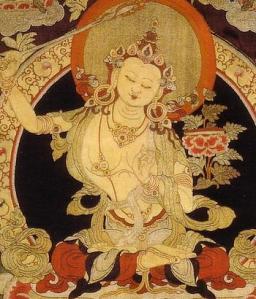
MañjuśrīAmongst the many things Tibetans inherited from India was a sense that names, when applied to exalted beings, are far more than mere verbal labels aiding identification. Deities’ names capture something of their essence, and reciting them is a form of invocation and praise. Most mantras have names at their heart, and there are whole texts, such as Mañjuśrī–nāma-saṃgīti (Reciting the Names of Mañjuśrī), devoted to lists of alternative names or epithets.
Lamas usually have several names too, and this can obviously lead to some confusion (of the kind already discussed in a previous post). Gene Smith outlined Jamgön Kongtrul’s many names in a lengthy section of his famous introduction to the Treasury of Knowledge (Shes bya mdzod), stating:

One of the greatest problems confronting the would-be bibliographer of Tibetan literature is the plethora of names, titles and epithets by which lamas are known, especially those of the older orders. The case of Kong sprul illustrates this problem especially well. Kong sprul was given seven types of name during his life: childhood name, monastic ordination name, bodhisattva vow name, tantric initiation name, name as a rediscoverer of hidden treasure, name as a grammarian, and finally an incarnation name.[1]

Continue reading

For Your Ears Only

teachingIn the beginning was the word. And the word was spoken… The teachings of the Buddha, as is well known, were not at first written down, but were preserved and passed on in oral form for several centuries. Even later, once the Buddhist canon became truly literary, newer — or, as the tradition has it, newly discovered — works, such as the Mahāyāna sūtras and, later still, the tantras, continued to be represented as records of oral teaching, prefaced with the famous statement: “Thus have I heard…” (evaṃ mayā śrutam…)

In Tibet, Buddhist literature abounds with texts deriving from the spoken. Consider, for example, such categories (or genres) as zhal gdams, gdams ngag, man ngag, zhal lung or zhal chems, where the oral associations are clear from the terms themselves. The collected works of important teachers in Tibet, too, are known as collected speech bka’ ‘bum or gsung ‘bum — (with speech in the honorific) rather than collected writings. (And let’s not forget that writings were themselves very often dictated to a scribe rather than penned by the actual author). Even the vast literature associated with the various treasure (gter ma) cycles — which is itself contrasted with the Kama (bka’ ma) or ‘Word’ in the Nyingma School — is said to contain the speech of Guru Padmasambhava.

In addition to the genres listed above, Tibetan Buddhism also features entire collections of teachings classed as oral (or aural), so-called ‘whispered transmissions’ (snyan brgyud). In its broadest sense, this category includes even Mind Training, which, according to the histories, was initially taught in secret and taught openly only from the time of Geshe Chekawa Yeshe Dorje (1101–1175).[1] Other examples are the Dakpo Nyengyü, Rechung Nyengyü, Orgyen Nyengyü and Thangtong Nyengyü. And in Bön there is the well-known Zhangzhung Nyengyü. Included within these collections are various forms of instruction once considered especially secret.

Continue reading

Approaches to Non-Sectarianism

The following post is based on my paper at the recent IATS conference in Bergen entitled ‘Highlighting Unity: Two Approaches to Non-Sectarianism in 20th Century Tibet’.

Introduction

Jamyang_Khyentse_Wangpo

Jamyang Khyentse Wangpo

The story of the Rimé (ris med) Movement is well-known — at least in outline, if not in detail. Although scholars have debated the appropriateness of the term “movement” (a controversy which I shall ignore in what follows), the achievements of Jamgön Kongtrul (1813–1899), Jamyang Khyentse Wangpo (1820–1892), Dza Patrul (1808–1887), and many more, are beyond dispute. And most followers of Tibetan Buddhism these days are familiar with how Eastern Tibet, particularly the Derge region, became the hub of a spiritual renaissance in the late nineteenth century: how texts were collected (or revealed) and compiled; how study colleges and retreat centres were founded; and how teachings and practices were transmitted on a vast scale.

But how non-sectarian was this Non-Sectarian Movement?

Some have suggested that it might not have been entirely impartial or unbiased. For one thing, it had little or no involvement from members of the dominant Gelug school — an apparent omission that prompted Geoffrey Samuel to contrast “Rimé shamans” with “Gelug clerics”. And some have even portrayed the movement as a reaction against the Gelug, a deliberate challenge to its ascendancy through the strengthening of the other schools and the preservation of once-endangered lineages.

Clearly, the Rimé did indeed lead to a strengthening of the non-Gelug schools. But this strengthening did not require their merging or combining. This is a point made emphatically by Ringu Tulku in his 2006 book, The Ri-me Philosophy of Jamgön Kongtrul the Great: “Ri-me is not a way of uniting different schools and lineages by emphasising their similarities.” Rather, he says, it involves “an appreciation of their differences and an acknowledgement of the importance of variety to benefit practitioners with different needs.”

Continue reading

Original Sins and the Mythical Origins of a Confessional Practice

Introduction

Vajrasattva

Vajrasattva

The “sins” of the title are not necessarily my own, although the origin of this post does perhaps lie in some mistakes I made in the (not too distant) past. In 2001, when Orgyen Tobgyal Rinpoche taught on the practice of confession known as Narak Kong Shak in Lerab Ling I served as his translator—a truly nerve-racking experience, as others can testify. I found the task particularly difficult when Rinpoche recounted the story translated below. Faced with a barrage of unfamiliar names and terminology, I could offer no more than a hopelessly garbled summary. What follows is therefore a long-delayed attempt to make amends for that initial mistranslation, and, hopefully, to provide an introduction to a significant but previously unexamined (in English, at least) myth.

The story of the brahmin Conch-Garlanded (Dung gi phreng ba can) and his betrayal at the hands of his own student, a prince—named Virtue-Beholder (dGe mthong) in some later versions—is referred to extensively in Nyingma literature, both in early terma revelations and in later kama (bka’ ma) compilations. It provides the origin for the confessional practice known as the ‘sovereign of remorseful purifications’ (’gyod tshangs rgyal po) and even the entire category of practices that appear under the rubric of “Dredging the Depths of Hell” (Na rak dong sprugs).

Continue reading

The Miraculous Death of the ‘Other’ Dakpo Tashi Namgyal

Introduction

ches dkon

Ches dkon pa’i sa skya’i mkhas grub chen po khag gsum gyi rnam thar

There are times when the apparent paucity of names available to Tibetans can prove confusing. If it seems as if Dharamsala has more than its fair share of Tenzins, for example, this is because so many of its residents have taken refuge with His Holiness the Dalai Lama, Tenzin Gyatso—who, following tradition, bestows his own first name on others. Still, when a second name is added the resulting permutations usually suffice to bring at least a degree of clarity. Yet there are some names that seem to have been deliberately contrived purely to confound the historian or the compiler of databases. Such a name is Dakpo Tashi Namgyal (dwags po bkra shis rnam rgyal), for as common as “Tashi Namgyal” might be in general—and TBRC lists at least sixteen notable examples from Tibetan history—it seems to defy the odds that there should have been two eminent teachers by that name who also acquired the prefix “Dakpo”.

Of these two, the later Dakpo Tashi Namgyal (1512/13–1587) is perhaps the better known today. He is chiefly remembered for being the author of a major work on Mahāmudrā, The Rays of Moonlight (phyag chen zla ba’i ’od zer), which has been translated into English by Lobsang Lhalungpa. (Another of his works on Mahāmudrā is included in the recent Mahāmudrā and Related Instructions, translated by Peter Alan Roberts.)

Continue reading

The Final Words of Orgyen Tendzin Norbu (1841–1900)

Introduction

Orgyen Tendzin NorbuOrgyen Tendzin Norbu (o rgyan bstan ‘dzin nor bu, 1841–1900) is something of an elusive figure in recent Nyingma history. Until recently, not much was known about his life, and even his dates were a mystery; his own writings appear to have been lost, and his final testament, recorded in the few brief biographies available to us, is decidedly enigmatic.

And yet he was certainly important, especially in the Nyingma scholastic tradition, not least as an intermediary between Gyalse Shenpen Thayé (rgyal sras gzhan phan mtha’ yas, 1800–1855) and Khenpo Shenga (gzhan dga’) or Shenpen Nangwa (gzhan phan snang ba, 1871–1927). Shenpen Thayé was Orgyen Tendzin Norbu’s uncle and the founder of the famous Shri Singha college at Dzogchen Monastery, and Shenga, his most illustrious disciple, helped, through his writings and teaching, to inspire a flourishing of scholasticism in early twentieth century Kham. Yet Orgyen Tendzin Norbu was more than simply a human bridge linking these two more prominent lamas; having studied with Dza Patrul Rinpoche (rdza dpal sprul o rgyan chos kyi dbang po, 1808–1887) for thirty years, he became an acknowledged scholar, Dzogchen master and important teacher in his own right.

Biographical information on Orgyen Tendzin Norbu was hard to come by until recently, and his dates are still quite muddled in the various sources. Some, including TBRC, give 1851 as the year of his birth, but, as recently pointed out in a comment on the Treasury of Lives site (on the Khenpo Shenga article) this date no longer seems tenable. Tulku Thondup did not provide any specific dates in his biography in Masters of Meditation and Miracles (pp. 226–227), and noted simply that Orgyen Tendzin Norbu lived in “the 19th century.” Nyoshul Khenpo’s Dzogchen history (2005, p.482) offered 1827–1888, based on the idea that the master passed away at the age of sixty in the earth-rat year (1888–9). Yet, according to Tendzin Lungtok Nyima (2004, p.594) in his vast history of Dzogchen Monastery and its associates, while Orgyen Tendzin Norbu did indeed live for sixty years, he died not in the earth-rat, but in the iron-rat year, i.e., 1900–1. This date, which has since been reproduced in other historical works published in Tibet, seems for the moment to be the most reliable.

Continue reading

Uniting Outer and Inner Solitude: Patrul Rinpoche’s Advice for Alak Dongak Gyatso

Introduction

Patrul_Rinpoche_new

Dza Patrul Rinpoche, Orgyen Chökyi Wangpo

In his account of the famous debate between Ju Mipham Namgyal Gyatso (’ju mi pham rnam rgyal rgya mtsho, 1846-1912) and Alak Dongak Gyatso (a lags mdo sngags rgya mtsho, 1824–1902),[1] Khetsun Sangpo Rinpoche tells us that Alak Dongak was so upset at losing the contest and seeing his treatise on Dzogchen burned in front of his teacher, Patrul Rinpoche (rdza dpal sprul o rgyan chos kyi dbang po, 1808-1887), that he broke down and wept.[2]

When I recently asked Tulku Thondup Rinpoche about this, he mentioned another possible explanation for Alak Dongak’s distress:

Khenpo Chemchok, my own teacher, used to say that on one occasion Könme Khenpo, my predecessor, asked Alak Dongak if it was true that he had cried after the debate with Mipham. Yes, he replied, he had wept, but it was not because he had lost the argument. In fact, he said, he had cried because Patrul Rinpoche had chastised him. Whenever he was winning, he said, Patrul would say to him, “I told you to meditate on love and compassion, but instead you’ve filled your head with all this scholarly stuff!” Yet whenever Mipham was winning, Patrul Rinpoche said nothing. Alak Dongak told Patrul, “I didn’t neglect your instructions. I have meditated on bodhicitta.” But it was the accusation of failing to apply his teacher’s instructions, he said, and not the humiliation of losing, that made him weep.

Continue reading